
The latest Annual Survey of Unincorporated Sector Enterprises (ASUSE) 2025 reported that India has nearly eight crore unincorporated establishments and employs roughly a fifth of India’s total workforce. Yet this vast sector contributes a meagre six per cent, or around Rs 20 lakh crore, to India’s total gross value added and offers the majority of its workers less than the minimum wage (ASUSE, 2025; EPW, 2026). This is the dichotomy central to India’s growth story where a sector that employs many, enriches very few of them.
Though the ASUSE 2025 paints a fairly optimistic picture of the sector, a longer, decade-long view tells a different story. The sector entered a sustained decline after 2016; while the exact causal weight of each factor is difficult to establish, demonetisation, the introduction of the Goods and Services Tax, and the Covid-19 pandemic are widely cited as contributing causes (EPW, 2024). Between 2015-16 and 2021-22, the number of establishments fell by 12 per cent and number of workers by 5.7 per cent. Growth in per-establishment GVA slowed sharply over the same period, to just 25 per cent, compared with 78 per cent in the preceding five years (2010-11 to 2015-16). Average daily earnings in the sector as per ASUSE 2025 — roughly Rs 385 in manufacturing, Rs395 in trade, and Rs 414 in other services — remain below India’s minimum-wage benchmark of Rs 478 a day for unskilled non-farm work (author’s own calculations from ASUSE 2025; Ministry of Labour and Employment, 2026). Only in the past two to three years has the sector regained momentum: the latest survey counts 7.92 crore establishments, up 8 per cent on the previous year, with gross value added rising by nearly 11 per cent.
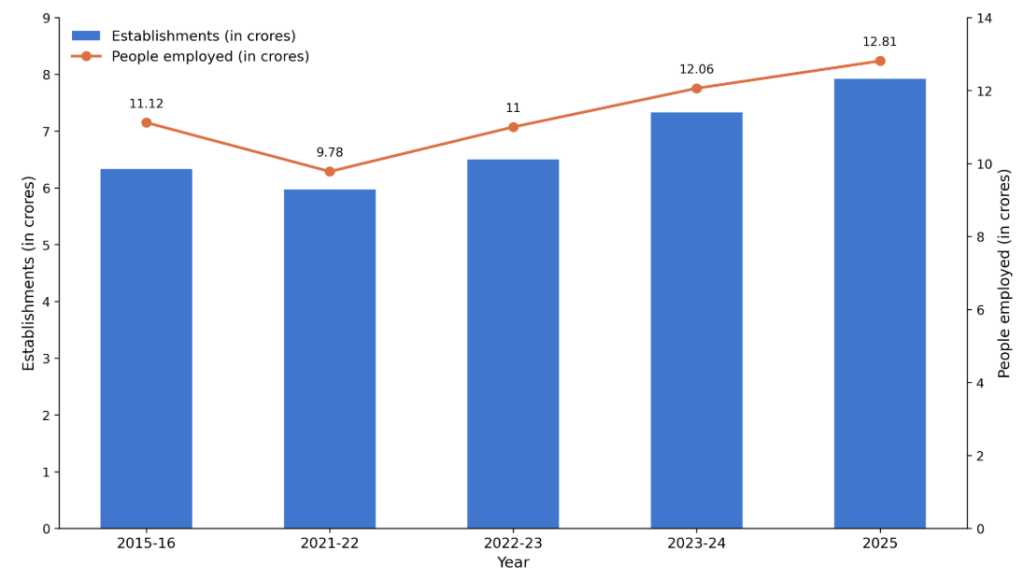
Fig 1:Total number of establishments and people employed in the unincorporated sector in India (Source: ASUSE reports)
The recovery has not been shared equally. The unincorporated sector comprises two broad categories of establishment: Own Account Enterprises (OAEs), which operate without any hired worker, and Hired Worker Enterprises (HWEs), which do. An overwhelming majority of establishments fall into the first category — solo operations with no hired help at all. Examined separately, the two categories reveal sharply diverging trajectories. While the number of OAEs and the workers engaged rose by approximately 29 per cent and 20 per cent, respectively, between 2015-16 and 2025; HWEs and their workforce grew by only 5 per cent and 8 per cent over the same period. This divergence matters because it is not merely a difference in growth rates but in returns: GVA per worker stands at around Rs 2.3 lakh in HWEs, nearly double the figure in OAEs. Economists have a name for this pattern: K-shaped growth, where the aggregate trend points upward even as the units composing it diverge, one branch pulling ahead while the other falls further behind (Chakrabarti et al., 2026). The implication for policy is significant — a single, undifferentiated approach to the entire unincorporated sector will fail to address this internal bifurcation; what the sector requires instead is differentiated, segment-specific intervention.
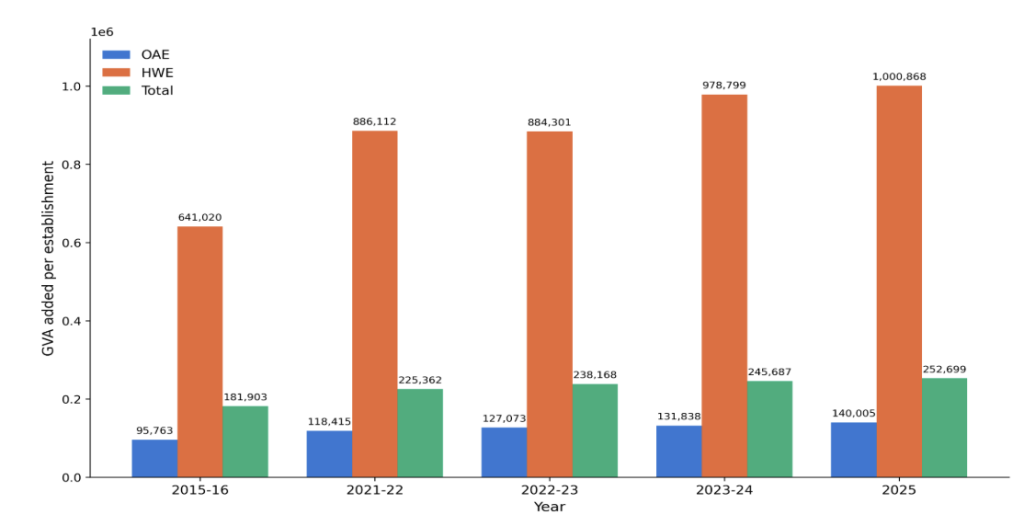
Fig 2: GVA added per establishment in India (Source: ASUSE reports)
Against the backdrop of the national context, Punjab’s unincorporated sector, presents problems that are, in important respects, sui generis. The state is undergoing a marked demographic shift: NFHS-5 recorded Punjab’s total fertility rate at 1.6, well below the replacement level of 2.1, and more recent estimates suggest it has fallen further still. Sustained youth outmigration, compounded by a rapidly ageing population, threatens to constrict Punjab’s working-age population significantly — a serious risk for an economy that is already under considerable strain. One plausible corrective is a rise in female labour force participation, which could help offset this shrinking workforce. However, ASUSE 2025 data also reveals a discouraging trend: women make up only 24.6 per cent of workers in Punjab’s unincorporated sector, which is lower than the national average of 28 per cent. The task, then, is not merely to draw more women into the sector but to ensure that the sector they enter does not become another low-income trap – precisely the trap this piece has just described at the national level.
A further concern is Punjab’s comparatively low productivity: annual GVA per establishment stands at around Rs3 lakh, against more than Rs 4 lakh in Haryana. This gap widens considerably in manufacturing, where Punjab’s GVA per establishment falls to Rs 2.4 lakh, roughly half of Haryana’s figure (ASUSE, 2025). This points to a deeper structural need: Punjab’s economy must diversify away from its dependence on agriculture. A revived unincorporated manufacturing sector could, in principle, absorb much of the underemployment currently disguised within agriculture — only if that absorption occurs through productive, hired-worker enterprises rather than a further expansion of low-return, own-account activity, which would simply relocate disguised unemployment rather than resolve it. For a state whose water table, cropping pattern, and farm incomes are all under mounting strain, a revived manufacturing base is not a policy nicety; it is close to the only credible route to genuine diversification away from land- and water-dependent farming.
The solution does not lie in building new institutions or launching schemes. There are several credit schemes (such as PM Vishwakarma, PM SWANidhi, and MUDRA), social security schemes (through e-SHRAM and Udyam registration) and industry-specific support (SFURTI and PMFME) already in place. Policy responses should attend to the sector’s internal divide rather than treating it as a monolith. For the OAE, which the data shows is closer to subsistence self-employment, the priority should be social protection. On the other hand, for the HWE, which generates nearly double per worker GVA, scaling up capital and market integration should be prioritised. For Punjab, the focus should be region and sector specific: expanding schemes such as SFURTI into the already existing industry clusters, such as Ludhiana, Jalandhar, Amritsar, etc., and accelerating the rollout of PMFME across the micro and small food-processing units for which the agricultural base already exists. Particular emphasis is needed on raising women’s participation in Punjab: better skilling through PMKVY, stronger financial inclusion and affordable credit access via SHGs, and reliable childcare support through initiatives such as the Palna scheme.
The mere growth in number of establishments and workers engaged in the sector is meaningless without the commensurate increase in the output, productivity and emoluments. Fixing this is not a technical footnote to India’s growth story. The objective of Sabka Saath, Sabka Vikaas would remain unrealised while the population this large remains structurally lagging. On the other hand, for a state as exposed as Punjab, alleviating this sector may well be its growth story itself.
Anmoldeep Singh is an intern at PANJ Foundation.