By: Manasvi
Last year, a working paper titled ‘Relative Economic Performance of Indian States: 1960-61 to 2023-24’ prepared by the Economic Advisory Council to the PM highlighted that Punjab’s share in the GDP peaked at 4.4% percent during the 1960s because of the Green Revolution. But it has been declining since the 1990s and reached 2.4 percent in 2023-24; possibly due to a form of ‘Dutch Disease’ because of the state’s overemphasis on agriculture. However, Haryana, which was formerly a part of Punjab, saw a different economic trajectory, with its share in GDP increasing following the initial boost given by the Green Revolution. Haryana’s share in GDP has increased from 1.9 percent in 1960-61 to 3.6 percent in 2023-24, owing somewhat to Gurugram’s success as an IT hub.
This report has reiterated the need for structural transformation to uplift the stagnated economy of Punjab. While discussing the solutions to Punjab’s recovery, Singh et. al. (2024) in their work ‘Economic Development of Punjab: Prospects and Policies’, mention that in addition to removing obstacles from Punjab’s current economic setup, Punjab needs to envision future sources of growth. They suggest investments in innovation to keep up with the growing trend of knowledge-intensive economic growth, something similar to what worked for Haryana. While state expenditure on innovation is key, studies suggest that diversity and inclusion in the STEM workforce significantly improves the quality of innovation.
While adequate representation of women in STEM is a worldwide concern, with women constituting 20 percent of the STEM graduates in some of the OECD countries in 2023, India boasts having one of the highest female STEM enrollments in the world- with 42.6 percent of its STEM students at higher education level being women, as per the AISHE 2021-22. However, a study by the Observer Research Foundation notes that India exemplifies a ‘leaky pipeline’ where women account for only 27 percent of the STEM workforce in 2023, which is below the global average of 30 percent.
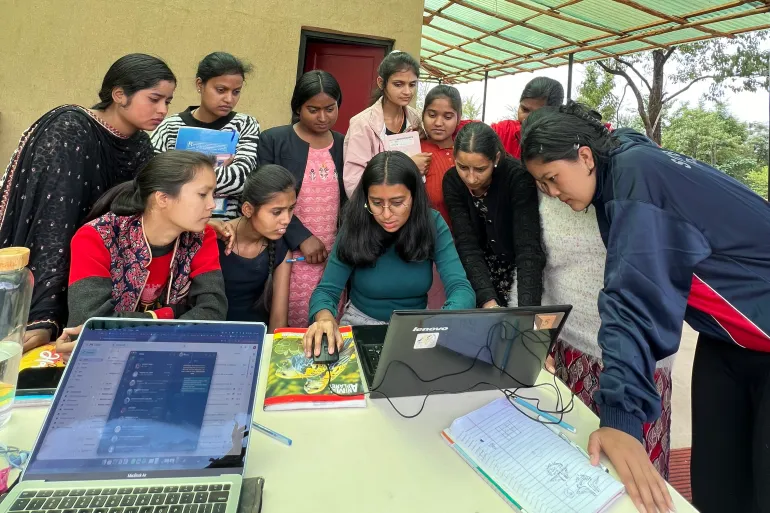
In Punjab, girls outnumber boys in choosing STEM subjects at school. According to the STI Data Portal of Punjab, 53 percent of the total students enrolled in STEM at the higher secondary level were female in the year 2022-23. An analysis of enrollment in 13 universities reveals that female students constituted 33.13 percent at the UG and 43.53 percent at the PG level in 2022-23. Similarly, data regarding women’s representation in 13 R&D institutions in Punjab suggests that they constitute 43 percent of both faculty and Ph.D. positions, as of 2022-23. However, this data reflects only government-sector employment, hence, comprehensive assessments of the organised private sector are also needed to inform targeted interventions.
A report by the Institute for What Works to Advance Gender Equality (IWWAGE) titled ‘Women in STEM: Challenges and Opportunities in India’ reveals that a number of socio-cultural factors like socialisation related to STEM being ‘masculine’, social norms related to early marriage, household responsibilities, restrictions on mobility due to puberty, and STEM education being expensive- affect women’s decision of pursuing a STEM course. Similarly, factors like hiring biases against women due to their reproductive and care-giving roles, gender-based pay disparities, and inflexibility of workplaces in terms of working hours, conditions & infrastructure affect the transition from enrollment to employment for women.
There are many centrally sponsored and state-sponsored schemes that focus on bringing and retaining females in academia and workforce, such as Consolidation of University Research for Innovation and Excellence in Women (CURIE), Women Science Schemes (WOS-A, B & C), WISE Post Doctoral Fellowship, WISE-KIRAN, etc. The majority of these schemes are focused on individual career progression in the public sector, leaving women in the private sector at the mercy of their superiors. However, identifying the employment-generating benefits of women entrepreneurship, many governments across the world are promoting this in STEM as a means to diversify the tech-based workforce. The Women in India’s StartUp Ecosystem Report (2023) prepared by ACT for Women in collaboration with the Udaiti Foundation has found out that women-led startups are more likely to perform better on gender equity in terms of giving more representation to women in managerial roles, adopting flexibility, granting maternity leaves, and having a lesser gender pay gap- emerging as a solution for sustainable employment of women in STEM.
To ensure adequate representation of its women in STEM, Punjab can improve its position by focusing on both fronts: encouraging women to choose STEM careers and making sure that they are retained in the workforce. Punjab’s STI Data Portal shows that 31.96 percent of state government schools offer science subjects at the higher secondary level. In addition to socialising the idea of STEM being gender-neutral, introducing science streams in more government schools, along with scholarships for women at the school and college level, can significantly improve female enrollment in STEM in Punjab.
With regards to the transition from STEM education to employment, promoting women entrepreneurship is something that Punjab can work on to ensure diversity in its workforce and take steps towards the much-desired innovation-led economic growth. While Punjab improved its performance in the India Innovation Index from 11th place in 2020 to 6th place in 2021 through efforts like Mission Innovate Punjab, the index highlights more potential as the state is underperforming in terms of grassroots innovations, new businesses and startups that it has produced. Through improving the investment and business environment for women-led tech enterprises, the state can harness this remaining potential, along with ensuring viable careers for women in STEM.
Punjab already has a commendable initiative in this direction called StartUps’ Handholding and Empowerment (SHE) that identifies, nurtures, and empowers women-led startups in STEM by providing guidance in entrepreneurship and seed grants. Additionally, the Punjab State Council for Science and Technology (PSCST) is working on creating a robust STI ecosystem through a network of incubators. However, while the specific data about women-led tech-based startups is not available, in 2024, 31 percent of MSMEs were owned by women in Punjab as per a PIB press release. While this is better than the national average of 20.5 percent, it is not among the best and points towards the need to improve the entrepreneurial ecosystem in Punjab, specifically for women. Dr. Jatinder Kaur Arora, Chairperson of the Advisory Board, North Regional S&T cluster and former Executive Director of PSCST, suggests that these enterprises can prosper if women are provided with specialised mentorship regarding entrepreneurship and networking. Punjab needs an ecosystem consisting of financing institutions, common facility centres, and incubators that not only help women to start enterprises, but also sustains them in a profitable manner. Additionally, the state government needs to devise a system to annually measure and track the representation of women in the STEM workforce.
Punjab can realise its long-term innovation-led growth potential by mainstreaming its women in STEM education and careers. This requires a combination of affirmative action, improving women’s access to STEM courses and jobs, along with attitudinal changes in favour of women amongst the people that constitute this ecosystem.
Manasvi is a P-LAB fellow at PANJ.